Hidden Gems of Amsterdam: When Canal Houses Whisper Secrets
You know how Amsterdam is famous for its gabled houses and canal rings? But what if I told you there’s another side—quiet courtyards, forgotten facades, and architectural whispers most tourists miss? I wandered beyond the postcards and found a city where every brick tells a story. From hidden courtyards to modernist surprises, Amsterdam’s lesser-known architecture is a quiet rebellion against the obvious. Let’s step off the crowded paths and explore the soul behind the stucco.
Beyond the Postcard: The Other Side of Amsterdam’s Architecture
Amsterdam’s image is etched into the global imagination: elegant canal houses with ornate gables mirrored in still waters, bicycles gliding past flower boxes, and narrow staircases climbing toward attic windows. These are the views that fill travel brochures and Instagram feeds. Yet beneath this polished surface lies a deeper architectural narrative—one shaped by centuries of trade, civic pride, social reform, and quiet innovation. While millions arrive each year to photograph the UNESCO-listed Canal Ring, few venture beyond the water’s edge to uncover the layers of history embedded in the city’s quieter streets and hidden corners.
The reason so many travelers see only the surface is not merely habit—it’s design. The canals were built to impress, to showcase wealth and order during the Dutch Golden Age. Their symmetry and grandeur were meant to dazzle, and they still do. But this very spectacle draws attention away from the subtle, the modest, the repurposed. The city’s true character often resides not in its showpieces but in its in-between spaces—alleyways, courtyards, back alleys, and neighborhoods just beyond the walking tours. These places reveal Amsterdam’s resilience, its practicality, and its enduring respect for communal life.
To discover this quieter side, one must shift perspective. Instead of rushing from museum to market, consider slowing down. Look upward at rooftop details, peer through half-open gates, and pause at buildings that don’t match their surroundings. Amsterdam rewards curiosity. A crooked façade might hint at 17th-century timber framing; a modern stucco block could be a 1930s social housing project; a plain doorway might lead to a centuries-old courtyard garden. The city’s architectural soul isn’t hidden—it’s simply waiting to be noticed by those who walk with intention.
Courtyards Behind the Walls: Amsterdam’s Secret Inner Worlds
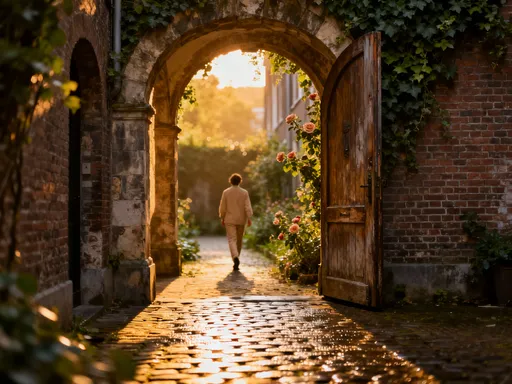
Step through an unmarked wooden door in central Amsterdam, and you might find yourself in a world untouched by time. Cobblestone paths wind between rows of small, gabled houses, their windows framed by ivy and geraniums. The air is still, the only sounds the rustle of leaves and distant church bells. These are the hofjes—charitable housing courtyards established by religious and civic groups in the 16th and 17th centuries. Originally created to provide shelter for widows, elderly women, and the poor, they remain among the city’s most serene and overlooked spaces.
The Begijnhof, tucked behind the busy Spui square, is perhaps the most famous of these courtyards. Founded in the late 1300s, it was once home to the Beguines, a Catholic women’s religious community. Today, it’s a protected site with a mix of timber-framed houses and a hidden chapel. Visitors often gasp upon entering—the contrast between the bustling street and this silent enclave is striking. Yet the Begijnhof is not alone. Dozens of hofjes still exist across Amsterdam, from the 17th-century Hofje van Nieuwkoop near the Rijksmuseum to the more modest Hofje van Loo in De Pijp.
What makes these courtyards remarkable is not just their beauty but their enduring function. Many still serve as affordable housing, preserving their original social mission. Their architecture reflects Dutch restraint—simple brickwork, symmetrical layouts, and minimal ornamentation. Yet within that simplicity lies elegance: hand-carved lintels, arched gateways, and carefully placed flower beds. These spaces were designed not for display but for dignity, offering residents privacy, community, and peace.
For visitors, accessing these courtyards requires respect. Some, like the Begijnhof, are open to the public during daylight hours. Others, such as those managed by housing foundations, are private and should only be viewed from the outside. H’ART Amsterdam, a cultural center in the former St. Elizabeth Hospital, offers guided tours of its adjacent hofje, blending history with contemporary art. The lesson here is clear: Amsterdam’s hidden architecture is not a spectacle to be consumed, but a living heritage to be honored.
The Forgotten Facades: Where Brickwork Tells Stories
Move beyond the canals, and Amsterdam reveals a different architectural language—one written in red brick, wrought iron, and functional design. In neighborhoods like the Eastern Docklands, Westerpark, and Oostpoort, former industrial zones have been transformed into vibrant residential and cultural districts. Yet many of the original buildings remain, their facades bearing the marks of a working city. These are not grand mansions but warehouses, factories, and schools—structures built for purpose, yet imbued with craftsmanship and quiet beauty.
The late 19th and early 20th centuries saw Amsterdam expand rapidly to accommodate a growing population and industrial economy. This era gave rise to a distinctive architectural style: utilitarian yet detailed, robust yet refined. Look closely at a former warehouse in Westergasfabriek, and you’ll notice stepped gables, arched windows with cast-iron frames, and decorative brick patterns. These were not decorative flourishes for the wealthy—they were signs of civic pride, built into structures meant for labor and production.
One striking example is the former gasworks complex in Westerpark, now a cultural hub. Its original buildings, constructed in the 1880s, feature tall chimneys, red-brick walls, and intricate metalwork. The site’s transformation preserved these elements, allowing visitors to walk through history while enjoying cafes, concerts, and art exhibitions. Similarly, in the Eastern Docklands, old shipyard offices and storage buildings have been converted into lofts and studios, their industrial bones exposed and celebrated.
Equally compelling are the schools and public buildings from this period. Many, like the former De Clercqstraat School, feature hand-carved stone details, stained glass, and ornate woodwork—proof that even public institutions were designed with care. These buildings reflect a belief that beauty and function are not opposites, but partners. They were meant to uplift, to inspire dignity in everyday life. Today, they remind us that architecture is not just about aesthetics—it’s about values.
Modernism in Disguise: Clean Lines Hiding in Historic Blocks
Amsterdam’s architectural story is not frozen in the 17th century. The early 20th century brought a wave of modernist design, driven by progressive ideals and a growing demand for affordable housing. Unlike the ornate styles of the past, this new architecture emphasized light, air, functionality, and social equity. Yet it did not shout—instead, it slipped quietly into the cityscape, often blending with older neighborhoods so seamlessly that most passersby don’t notice.
The Plan Zuid development, designed by architect H.P. Berlage in the 1920s, is a landmark of this movement. Inspired by garden city principles, it combined spacious layouts, green spaces, and modernist aesthetics to create humane living environments. The Chassé Street area, part of this plan, features buildings with flat roofs, horizontal window bands, and minimalist stucco façades—hallmarks of the Amsterdam School and early functionalism. These designs rejected excess in favor of clarity and purpose.
Another standout is De Dageraad (The Dawn), a housing complex in the Spaarndammerbuurt neighborhood. Completed in 1923, it was one of the first large-scale social housing projects in the Netherlands. Designed by Michel de Klerk and Piet Kramer, it combines expressive brickwork with geometric forms and playful details. Though modest in scale, it radiates dignity. Each apartment was designed with sunlight, ventilation, and private outdoor space in mind—radical concepts at the time.
What makes these buildings remarkable is their quiet confidence. They don’t compete with the gabled houses of the Golden Age; they coexist. A sharp-angled modernist block might sit beside a crooked timber-framed house, creating a dialogue across centuries. This architectural layering is part of Amsterdam’s charm. It shows a city that values progress without erasing the past, that embraces innovation while honoring craft. For the observant traveler, spotting these modernist gems becomes a kind of treasure hunt—one that rewards patience and attention.
Canal Houses Up Close: Not Just Pretty Faces
Every visitor to Amsterdam photographs the canal houses. Their gables—bell-shaped, neck, or step—rise like lace against the sky. But behind their picturesque façades lie ingenious solutions to practical challenges. These buildings were not designed for beauty alone; they were shaped by necessity, ingenuity, and the city’s unique geography. Understanding their details transforms them from postcard images into living lessons in engineering and adaptation.
One of the most striking features is the way many houses lean forward. This is not a sign of decay—it’s by design. In the 17th century, hoisting goods to upper floors was done with pulleys attached to beams at the top of the house. A forward tilt prevented crates from crashing into the façade during lifting. Today, some of these beams remain, often carved with family emblems or decorative motifs. They are silent witnesses to a mercantile past.
Another common trait is the narrowness of the houses. Plots along the canals were taxed by width, so builders made them as slim as possible—sometimes less than 15 feet across. To compensate, the houses stretch far back, sometimes spanning an entire city block. This created a distinctive layout: long, narrow interiors with rooms arranged in sequence, connected by steep staircases. The upper floors often narrow further, supported by wooden beams that rest on stone foundations below ground—necessary in a city built on marshland.
The foundations themselves are marvels of early engineering. Most canal houses rest on wooden piles driven deep into the soft soil—often 50 to 70 feet down—until they hit firmer ground. These piles, usually made of alder or pine, remain stable as long as they stay submerged in water. But if the water table drops, they can rot, leading to subsidence. This is why the city carefully monitors groundwater levels and invests in foundation maintenance. It’s a delicate balance, a constant dialogue between water and structure.
Today, many of these houses have been restored with modern reinforcements, but their original features are preserved. Guided architectural tours, such as those offered by the Amsterdam Heritage Foundation, help visitors read these buildings like texts. A carved gable stone might tell a family’s trade; a window shape might indicate its historical use. These details turn a casual stroll into a journey through time.
Adaptive Reuse: When Old Buildings Get New Lives
Amsterdam has a deep respect for its architectural heritage, but it does not treat old buildings as museum pieces. Instead, the city excels at adaptive reuse—transforming historic structures into functional, modern spaces without losing their character. This approach reflects a sustainable mindset, one that values continuity over demolition. From churches to power stations, Amsterdam gives old buildings new purposes, ensuring they remain part of daily life.
One of the most dramatic examples is the Eye Filmmuseum, located across the IJ waterway. Housed in a striking white building that resembles a ship or a wave, it was constructed on the site of a former industrial complex. But the true story lies in what it replaced: a neglected waterfront area. The museum’s design, by Delugan Meissl, combines futuristic form with respect for the surroundings, creating a cultural beacon that draws both locals and tourists.
Another success story is De Hallen, a cultural complex in the Oud-West neighborhood. It occupies a converted tram depot from the 1900s, preserving its steel trusses, brick walls, and industrial scale. Inside, it now hosts a food hall, art house cinema, design studios, and exhibition spaces. The blend of old and new is seamless—the building’s history is visible in every beam and tile, yet it functions effortlessly in the 21st century.
Churches, too, have found new roles. The former St. Willibrordus Church in De Pijp is now a bookstore and event space, its vaulted ceilings and stained glass creating a majestic reading environment. Similarly, the Westerkerk’s ancillary buildings now house community centers and offices. These transformations are not about erasing the past but reinterpreting it—allowing architecture to evolve while retaining its soul.
The philosophy behind adaptive reuse is simple: buildings have stories, and those stories deserve to continue. By repurposing rather than replacing, Amsterdam honors its history while embracing the future. For visitors, these spaces offer more than utility—they provide a sense of continuity, a reminder that cities are living organisms, constantly adapting.
How to See Amsterdam Like an Architecture Lover
Seeing Amsterdam through an architectural lens doesn’t require a degree in design—it requires curiosity, patience, and a willingness to wander. The city rewards those who step off the main routes, who look up as well as ahead, who pause at unassuming doorways and side streets. With a few simple strategies, any traveler can deepen their experience and discover the city’s quieter layers.
Begin with slow walking. Instead of rushing from museum to market, choose a neighborhood and explore it thoroughly. The Grachtengordel’s side canals—like Herengracht’s quieter tributaries—are less crowded and reveal more intimate architecture. Notice how house heights vary, how colors shift, how courtyards peek through gates. Bring a guidebook or use an app like “Amsterdam Architecture Walks” to identify styles and periods.
Visit at off-hours. Early mornings and weekdays offer a different perspective—fewer crowds, softer light, and a chance to observe daily life. Courtyards are best visited in the morning, when residents are awake but not disturbed. Industrial areas like Westerpark are peaceful in the late afternoon, perfect for photography.
Consider guided tours. Organizations like the Amsterdam Heritage Foundation and the Netherlands Architecture Institute offer themed walks on topics ranging from canal house engineering to modernist housing. These are led by experts who share stories not found in guidebooks. Alternatively, rent a bike and follow self-guided routes through Nieuw-West, a garden city neighborhood with diverse 20th-century styles.
Finally, cultivate a mindset of observation. Ask questions: Why does this building lean? What was this space used for? How does old meet new here? These questions turn sightseeing into discovery. They connect you not just to bricks and mortar, but to the people who built them, lived in them, and preserved them.
Amsterdam’s architecture isn’t just in guidebooks—it’s in the silence between bricks, the curve of a forgotten gate, the way light hits a restored facade. By stepping beyond the famous canals, we don’t just see the city differently—we connect with its quiet resilience. These hidden forms remind us that beauty thrives in subtlety, and history speaks softly to those who listen. The next time you walk through Amsterdam, slow down. Look closer. The city is whispering—will you listen?